The Profitability Trap: Why Garages Confuse Markup vs. Margin
In most independent garages, technical competence isn’t the issue. You can diagnose a stubborn electrical fault, replace a clutch, or carry out a timing belt job without thinking twice. Yet despite all that skill on the workshop floor, many garages quietly lose profit every single month for a far simpler reason.
They confuse markup with margin.
It sounds like semantics, but it isn’t. If your garage spends around £10,000 a month on parts, using those two terms interchangeably can cost you thousands of pounds a year in realised profit, money that should be in your bank account, not leaking out unnoticed.
At first glance, markup and margin appear similar. Both use the same numbers: cost price and selling price. The difference lies in how you look at them. Markup is the percentage you add to your cost when pricing a part. Margin, on the other hand, tells you how much of the final selling price is actually profit. Markup looks upward from cost; margin looks backward from revenue. One helps you set a price. The other tells you whether your business is healthy.
This distinction becomes painfully clear when you look at real numbers.
Imagine your garage spends £10,000 per month on parts and you decide you need a 30% profit to cover overheads and grow. Many owners assume this means adding 30% to the cost. So the calculation becomes simple: £10,000 multiplied by 1.3 gives a selling price of £13,000. That feels right. You’ve added £3,000 in profit.
The problem is that £3,000 isn’t 30% of £13,000. It’s 23.1%.
That’s the markup trap.
To achieve a true 30% margin, the calculation has to start with the selling price, not the cost. In this case, £10,000 divided by 0.7 gives you a selling price of £14,285. Now the profit is £4,285, and that really is 30%.
The difference between those two approaches is £1,285 every month. Over a year, that’s £15,420 quietly disappearing, not through bad workmanship or wasted time, but a simple misunderstanding of pricing.
That money could buy a new ramp, take pressure off cash flow, fund an apprentice, or pay for software. Instead, in thousands of garages, it simply never arrives.
The most profitable workshops recognise that not all parts should be priced the same way. They don’t rely on one flat rate across everything. Low-cost, high-volume items like oil filters, bulbs, and consumables often require very high markups, sometimes 100% or more, because the administrative time spent ordering, handling, and invoicing them, dwarfs the cost of the part itself. High-ticket items such as gearboxes or turbos are different. Here, margin matters more than markup. A 30% margin on a £2,000 component is meaningful profit, but excessive markup risks sending the customer elsewhere entirely.
Getting pricing right does more than boost headline profit. It protects you from the invisible costs most garages forget to factor in: time spent on the phone to factors, electricity and tooling, storage, and warranty risk when parts fail. Margin absorbs those costs automatically. Markup doesn’t.
It also sharpens decision‑making. When you understand your margin, you know exactly how much of every invoiced pound is yours. If a loyal customer asks for a discount, you can say yes or no with confidence instead of relying on gut feel or hope.
That’s why the better question to ask isn’t “What’s my markup?” but “What’s my blended margin across parts and labour?”
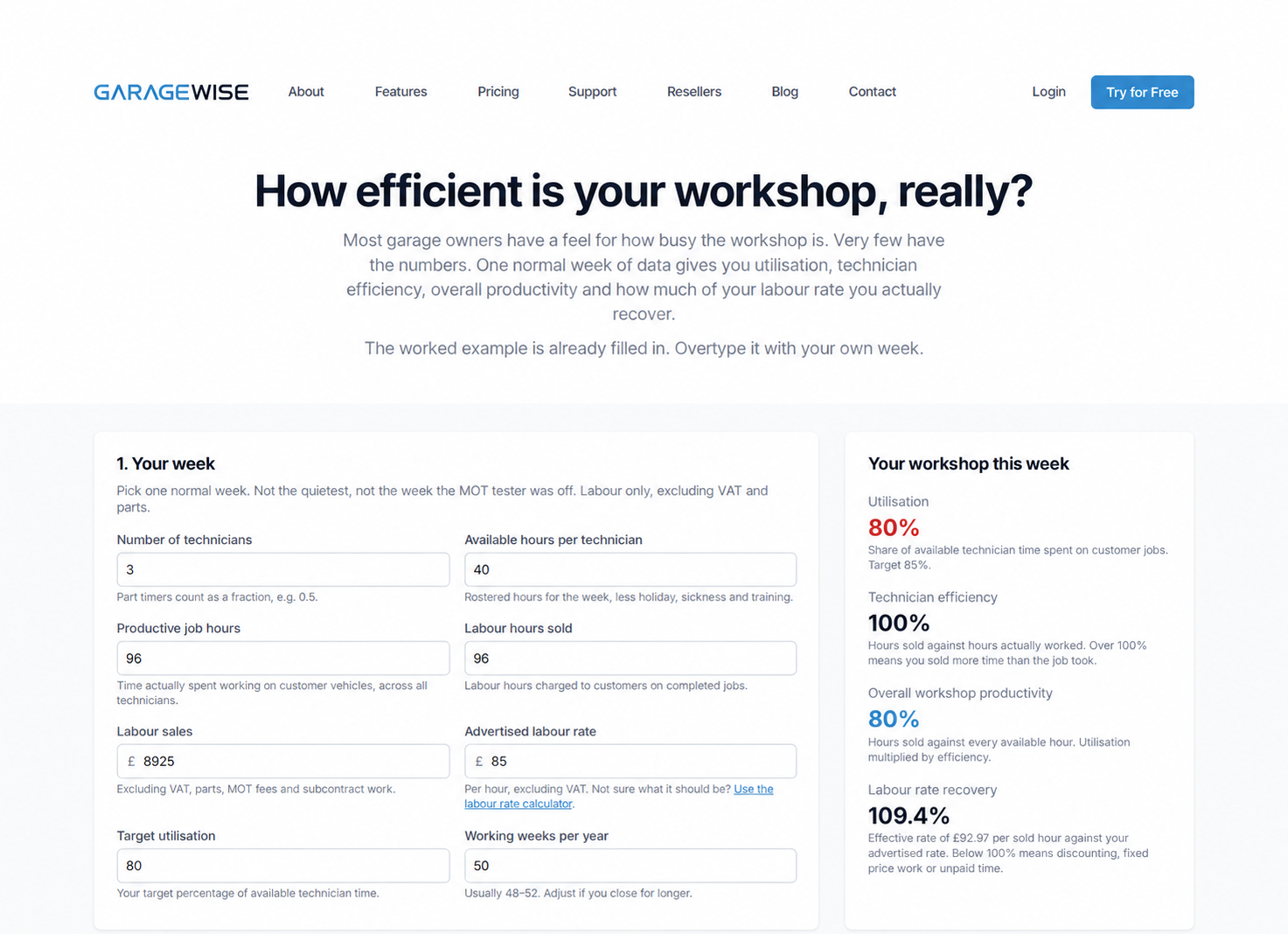
If your parts are only returning 23% instead of the 30% you think you’re making, then your total margin is being carried by labour alone, and that puts pressure on efficiency, utilisation, and pricing elsewhere in the business.
What’s interesting is what happens after you fix the maths.
Recovering that missing £1,285 a month doesn’t just improve the bank balance; it creates breathing room. Instead of being absorbed by day‑to‑day pressure, that reclaimed profit can be reinvested into systems that remove friction from the working day and help the workshop run more smoothly.
This is where an all‑in‑one garage management system like GarageWise adds real value. By bringing together job management, customer records, scheduling, and technical repair data into a single system, it reduces the duplication, delays, and guesswork that quietly eat time and profit. Everyday tasks become quicker and more straightforward, not because people work harder, but because the system does more of the heavy lifting.
When pricing, job progress, parts, and technical information all live in one place, margins are protected by default. Jobs are priced consistently, work flows more predictably through the workshop, and small oversights stop eroding profit in the background. The benefit isn’t just financial; it’s operational. Fewer interruptions, clearer visibility, and less firefighting.
Seen in that light, GarageWise isn’t simply a piece of software or another overhead. Used properly, it becomes part of the infrastructure of the business, supporting technicians, advisers, and owners alike, while quietly improving efficiency and control day in, day out.
And that brings the conversation full circle. When you shift your thinking from markup to margin, you’re not charging more. You’re building a workshop that is calmer to run, easier to manage, and far more profitable over the long term.
Fixing the maths is the first step. Running better systems is the next.
Start a free 14‑day trial of GarageWise and see how bringing job management, scheduling, customer records, and technical data into one system changes the way your workshop runs.